
Many patients considering dental implants ask the same question: what will it actually look like once it is in my mouth? If you have a missing or damaged tooth, it is natural to wonder whether an implant will blend in or whether people will notice it when you smile.
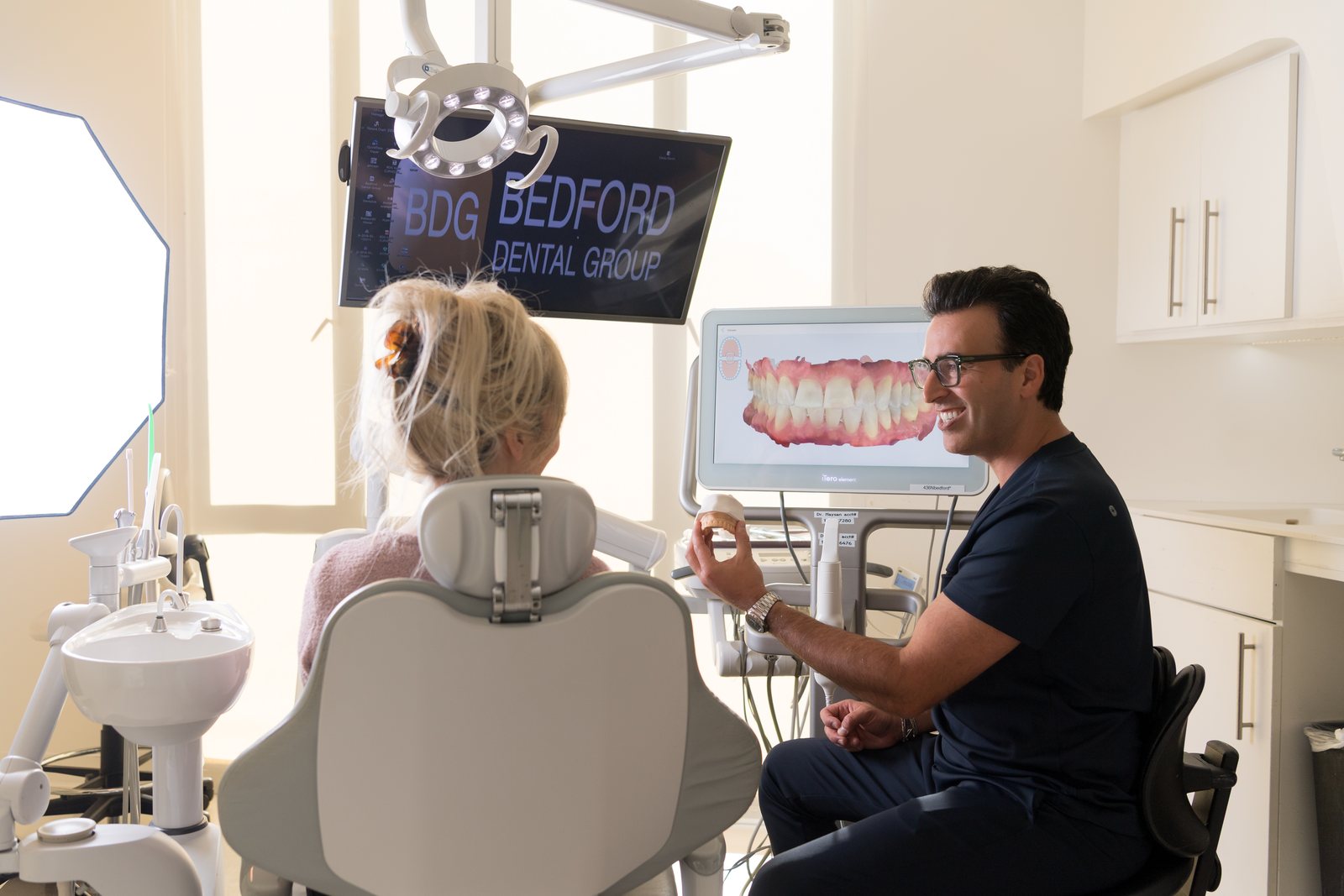
At Bedford Dental Group in Beverly Hills, Dr. Daniel Naysan plans implants to look as close to natural teeth as possible. When an implant is planned and placed well, the visible tooth is very hard to tell apart from the teeth beside it.
Below is a straightforward look at what dental implants look like, how the parts work together, what gives an implant a natural appearance, and when it can look less natural.
What do dental implants look like?
Dental implants look like natural teeth once they are finished. The part you see is a custom crown, shaped and shaded to match the teeth beside it. Below the gum is a small screw-shaped post, usually titanium or zirconia, that replaces the root, plus a connector called an abutment that holds the crown in place.
The American Dental Association describes implants as designed to blend in with your other teeth, with the crown customized in size, shape, color and fit.
What Dental Implants Look Like Above the Gumline
When people ask what implants look like, they almost always mean the visible part of the restoration. That part is the crown, made to mimic the tooth it replaces.
A finished implant crown has:
- Translucency at the edges, like natural enamel
- A shape and size that mirror the matching tooth on the other side
- A shade matched to your neighboring teeth
- A smooth surface with a natural shine
It fills the space where your tooth was, supports your bite and restores the symmetry of your smile. Implants can also support a bridge or a full arch of teeth, in which case the visible part is a set of connected teeth rather than a single crown.
What Implants Look Like Below the Gumline
The parts you cannot see are what make an implant stable.
The implant post. This is a small, screw-shaped post placed in the jawbone, roughly the size of a tooth root. It is made of titanium or zirconia. Over several months it fuses with the bone, a process called osseointegration, and becomes the new root.
The abutment. Once the post has healed, a connector called an abutment is attached to it. It sits at or just under the gumline and holds the crown. It does not show when you smile.
Before the final crown goes on, the implant site may have a small healing cap or a temporary tooth. If you have seen photos of a metal post sticking out of the gum, that is this in-between stage, not the finished result.
Do dental implants look natural?
Yes, in most cases. A single implant crown, made to match and set in healthy gums, usually looks like a natural tooth to anyone who is not a dentist looking closely.
The hardest part of a natural look is the gum, not the crown. The small triangle of gum between two teeth, called the papilla, is what keeps a dark gap from showing at the gumline. Research shows it depends on the bone underneath. In a study of single implants in the Journal of Periodontology, the papilla was almost always present when the distance from the contact point between the teeth to the bone was 5 mm or less, and present half the time or less at 6 mm or more.
Two implants side by side in the front of the mouth are harder still. A study of adjacent implants found the gum between them averaged 3.4 mm in height, shorter than between natural teeth. That is why planning matters most for front teeth, and why a dentist may suggest a different design, such as one implant supporting two teeth, when two neighboring front teeth are missing.
Why Dental Implants Look So Real
Several things work together to make an implant look like a natural tooth:
Custom Color Matching
The crown is shade-matched to your natural teeth, including the undertone and the translucency at the edge. If you plan to whiten your teeth, it is done before the crown is made, because a crown keeps its color.
Shape and Contouring
The crown is shaped to match the curve, length and width of the tooth it replaces and the tooth on the opposite side, so it fits in with your bite and your smile.
Natural Gumline Integration
When the implant is placed at the right depth and angle, the gum sits around the crown the way it sits around a natural tooth. That frame of gum is a large part of what makes the tooth look real.
Porcelain or Zirconia
Implant crowns are made of porcelain or zirconia, materials that reflect light much like enamel does, so the tooth looks natural in daylight, in photos and under indoor lighting.
Titanium or Zirconia: Does the Implant Material Change the Look?
Usually not, because the post is hidden in the bone. Material starts to matter when the gum is thin. A titanium post or abutment can sometimes show as a grayish shadow through thin gum or if the gum recedes later. A zirconia implant or a zirconia abutment is white, so there is no gray to show through.
Zirconia implants are a metal-free option, planned and placed by Dr. Naysan at Bedford. The zirconia implants page explains when they suit a case.

How Dental Implants Compare to Dentures and Bridges
| Feature | Dental implant | Dental bridge | Removable denture |
|---|---|---|---|
| What you see | A single crown that comes out of the gum like a natural tooth | A row of connected crowns, with a false tooth in the middle | Teeth set in an acrylic base that rests on the gums |
| Effect on nearby teeth | None; the implant stands on its own | The teeth on either side are prepared for crowns | Partials may clip to nearby teeth |
| Jawbone | Supports the bone where the root was | Does not replace the root, so bone can shrink under the false tooth | Does not replace the root |
| Stability | Fixed; does not move when you chew | Fixed | Can shift; may need adhesive or adjustments |
| Looking natural | Close to a natural tooth when gum and bone are healthy | Can look natural; the gum under the false tooth may look different over time | Depends on fit; the acrylic gum may show when you smile |
The ADA notes that implants, bridges and dentures are all ways to replace missing teeth. Implants are often the closest to the look and feel of natural teeth because they replace both the root and the visible tooth. The dental bridge vs implant guide compares those two in more detail.
What Determines Whether an Implant Looks Natural
A natural-looking result depends on four things working together.
1. Careful Clinical Planning
Imaging and a bone assessment show where the implant can go and at what angle, so it sits in the same position as a natural root. A post placed at the wrong angle can push the crown out of line with your other teeth.
2. Enough Healthy Bone
The gum follows the bone. If bone has been lost after an extraction or a long gap, a bone graft may be needed first to rebuild it. The bone grafting page explains how that works.
3. Healthy Gums
Gum disease is treated before an implant, and healthy gums around the implant keep it looking natural for years. The ADA notes that diabetes and tobacco use can slow healing.
4. A Well-Made Crown
The crown is made by a dental lab to the shade and shape planned for your smile. For front teeth, the shade is often checked against your natural teeth in daylight before the crown is finished.
Do implants ever look fake?
They can, and it helps to know why. An implant usually looks less natural for one of these reasons:
- The shade does not match, often because the teeth beside it were whitened or darkened after the crown was made.
- A dark or gray line shows at the gumline, from thin gum or gum recession over a titanium post or abutment.
- A dark triangle shows between the teeth, where the papilla did not fill in because of bone loss.
- The crown is too long or the wrong shape, often because bone was lost before the implant was placed.
Most of these are planned for before the implant goes in, which is why the consultation and imaging matter as much as the procedure itself.
How Long Do Dental Implants Last?
Implants have a long track record. A systematic review of 18 studies in the Journal of Dentistry found that 96.4% of implants were still in place after 10 years. The crown on top can wear or chip over time and be replaced without changing the implant.
Frequently Asked Questions About Natural-Looking Dental Implants
Will people be able to tell I have a dental implant?
In most cases, no. A crown that is shade-matched and set in healthy gum looks like a natural tooth in conversation and in photos. A dentist may spot it on an X-ray.
Do front-tooth implants look natural?
They can, but front teeth take the most planning, because the gum and the papilla between the teeth are visible when you smile. Enough bone, healthy gums and careful positioning make the difference. When two neighboring front teeth are missing, the dentist may suggest a design that avoids two implants side by side.
Do implants look different under certain lighting?
Porcelain and zirconia crowns reflect light much like enamel, so a well-made implant crown looks natural in daylight, indoor light and photos. Very bright or blue light can show small differences between any restoration and natural teeth.
What does a dental implant look like before the crown is placed?
During healing you may see a small metal or white healing cap at the gumline, or a temporary tooth. The post itself sits in the bone and is not visible. The final crown goes on once the implant has fused with the bone.
Can an implant crown be whitened?
No. Implant crowns keep their color, so whitening only lightens your natural teeth. If you want whiter teeth, whiten them before the crown is made so it can be matched to the new shade.
Are zirconia implants more natural looking than titanium?
The finished tooth can look the same with either, because the post is hidden in the bone. Zirconia can help when the gum is thin, because there is no gray metal to show through.
Do implants ever look fake?
They can if the shade does not match, if a gray line shows at the gumline, or if bone loss leaves a dark gap between the teeth. Careful planning, bone grafting where needed and a crown matched to your teeth prevent most of these problems.
How much do dental implants cost at Bedford?
The fee for an implant is quoted after an examination and imaging, because it depends on whether bone grafting is needed, the implant material and the type of crown. You receive the plan and the fee in writing before treatment begins.
Restore a Natural-Looking Smile at Bedford Dental Group
A natural-looking implant starts with a careful plan. At a consultation, Dr. Naysan checks the bone and gum around the gap, explains your implant and crown options, and shows you what the finished tooth is planned to look like.
Request a consultation or call (310) 278-2424. Bedford Dental Group, 436 N Bedford Dr., Suite 300, Beverly Hills, CA 90210. For more on implants at Bedford, see the dental implants page.
