

© 2026 Bedford Dental Group. All Rights Reserved.
Case study
Layered e.max Veneers and Onlays for Severely Worn, Yellowed Teeth
Worn enamel had yellowed this patient's teeth and lowered the bite; layered e.max veneers and four onlays restored the bite's height over two main visits.

Treated by Dr. Daniel Naysan, DDS
Bedford Dental Group, Beverly Hills
- Case
- Severely worn, yellowed enamel
- Treatment
- 24 units (20 veneers + 4 onlays)
- Visits
- 2 main visits over about 3 weeks
- Treating doctor
- Dr. Daniel Naysan, DDS
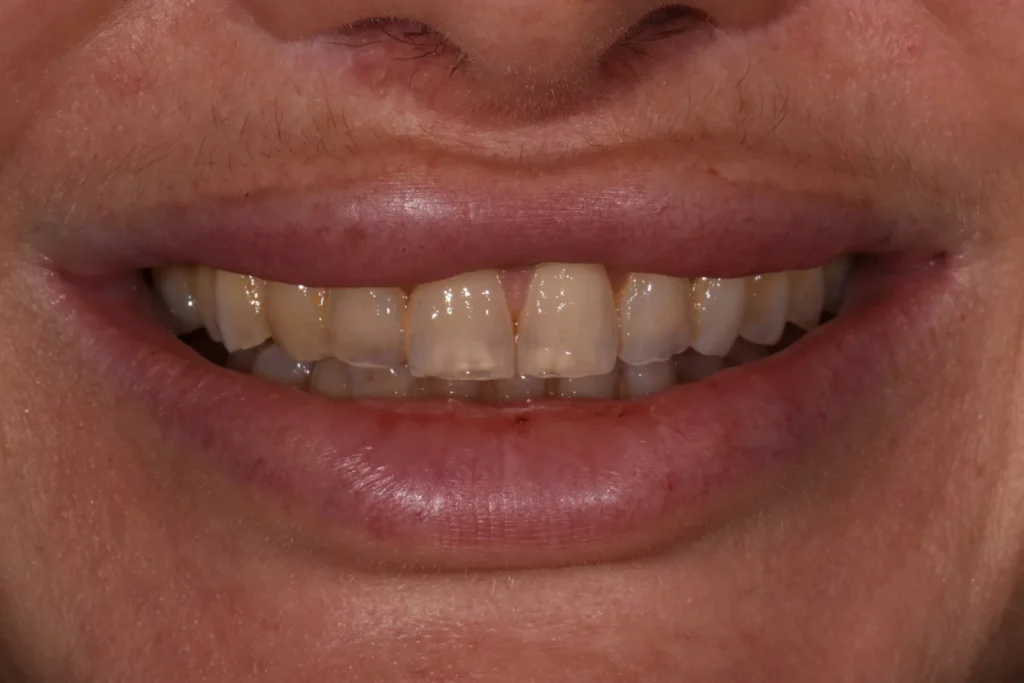
Before

After
Before and after: 20 layered e.max veneers and four porcelain onlays by Dr. Daniel Naysan rebuilt severely worn enamel and raised a worn-down bite.
These before-and-after photographs show one Bedford Dental Group patient’s actual treatment result. The same results may not occur for all patients.
Teeth treated
- Porcelain veneer (20)
- Porcelain onlay (4)
Universal numbering, shown as if facing the patient.
Dental arch diagram. 24 teeth treated. Porcelain veneer: teeth 4, 5, 6, 7, 8, 9, 10, 11, 12, 13, 20, 21, 22, 23, 24, 25, 26, 27, 28, 29. Porcelain onlay: teeth 18, 19, 30, 31.
Case details
Diagnosis
- Presenting condition
- Severely worn, thin enamel with a worn-down deep bite, giving the teeth a yellow, aged appearance; areas of decay
- Complicating factors
- Heavily worn enamel affecting the bite; decay removed during preparation
Treatment
- Treatment performed
- 20 porcelain veneers and 4 porcelain onlays to raise the bite (increase the vertical dimension of occlusion)
- Teeth treated
- 24 teeth. Veneers: #4–13 (upper) and #20–29 (lower). Onlays: #18, #19, #30, #31. Universal numbering.
- Preparation
- Minimal preparation, guided by a mock-up
- Anesthesia / sedation
- Oral conscious sedation
- Visits and duration
- 2 main visits over about 3 weeks
- Treating doctor
- Dr. Daniel Naysan, DDS
Materials
- Materials and lab
- Layered e.max (lithium disilicate ceramic), Beverly Hills Dental Lab
- Shade
- 0M2 (VITA 3D-Master)
What was the patient’s concern?
This Bedford Dental Group patient had severely worn, thin enamel that made the teeth look yellow and the smile look older.
“My smile makes me look older and distressed.”
What did the examination find?
Dr. Daniel Naysan’s examination found a worn-down bite (occlusion) and some areas of tooth decay that the patient had not mentioned. The wear had reduced the teeth enough to change how the upper and lower teeth came together. Dr. Naysan removed the decay and incorporated it into the preparation of the teeth for their new restorations.
What options were considered, and why porcelain veneers?
Dr. Naysan considered crowns for this case and ruled them out: crowns would have meant removing more tooth structure, and he preferred the more conservative preparation that veneers allow. The problem here was lost tooth structure and lost bite height rather than color alone, so the plan paired 20 veneers with four onlays that restore the height of the bite.
How was the treatment carried out?
Dr. Naysan completed 24 restorations, 20 veneers and four onlays, in two main visits over about three weeks. He planned the function of the bite alongside the look of the smile, then prepared the teeth conservatively from a mock-up and placed provisional restorations the patient wore and gave feedback on. Beverly Hills Dental Lab made the final restorations in layered e.max, a lithium disilicate ceramic, in shade 0M2. See the full porcelain veneer process.
What made this case difficult?
Key point
The challenge in this case was the heavily worn enamel, which had created problems with how the teeth came together.
Dr. Naysan planned the bite as carefully as the appearance of the smile, and he reports that this planning gave the case a predictable outcome and a good long-term prognosis.
What was the result?
Raising the vertical dimension of occlusion, the height of the bite when the teeth close, improved both how this patient’s teeth function and how the smile looks. Dr. Naysan notes that restoring that lost height also gave more support to the lower third of the face.
How long will it last, and what upkeep does it need?
Dr. Naysan expects the layered e.max veneers and onlays in this case to last about 20 years, with an evaluation every six months. Lifespan varies from patient to patient with home care, bite forces and regular dental visits. Read veneer aftercare guidance.
How long did the treatment take?
This 24-unit veneer and onlay case took two main visits over about three weeks at Bedford Dental Group in Beverly Hills.
Is this treatment right for you?
Veneers with onlays to raise the bite suit someone with a worn-down, deep bite and heavily worn enamel that has left the teeth looking yellow. Someone whose teeth are discolored but not worn, with a healthy bite, would not need onlays or a bite raise and may be a candidate for a smaller treatment.
See what is possible for your smile
Every case is planned around one patient’s teeth, bite and goals. Book a consultation with Dr. Daniel Naysan at Bedford Dental Group in Beverly Hills.
Schedule a consultation