

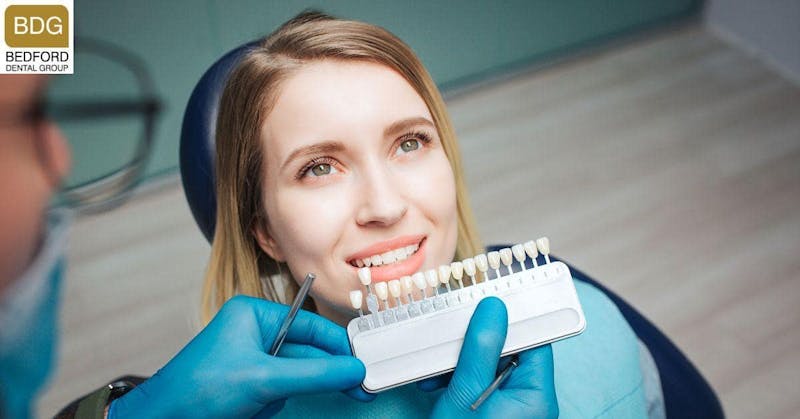
In many cases, veneers are ideal for patients seeking aesthetic refinement with a conservative approach, while crowns are better suited for teeth that require structural reinforcement or full coverage.
At Bedford Dental Group in Beverly Hills, this decision is never made in isolation. Led by Dr. Daniel Naysan, our approach is grounded in facial analysis, biomimetic principles, and precise treatment planning. Rather than defaulting to a single solution, we evaluate each option's impact on both the appearance and long-term integrity of your smile.
This guide will walk you through the key differences between veneers and crowns, when each is recommended, and how to determine which is right for you.
What Are Veneers?
Porcelain veneers are ultra-thin ceramic shells bonded to the front surface of the teeth to refine their appearance while preserving as much natural tooth structure as possible. They are commonly used to enhance:
- Shape and contour
- Color and brightness
- Proportion and symmetry
- Minor alignment irregularities
Because veneers require less preparation than crowns, they are often considered a more conservative cosmetic solution. According to the American Dental Association’s overview of veneers, they are frequently used to address:
- Discoloration that does not respond to whitening
- Slight misalignment
- Worn or uneven edges
- Small gaps between teeth
What Are Dental Crowns?
A dental crown is a full-coverage restoration that encases the entire tooth. It is typically used when a tooth has been significantly weakened, fractured, or structurally compromised.
Crowns restore both strength and function, making them essential when a tooth cannot support a more conservative option. Research explains dental crowns as a standard solution following root canal treatment, large fillings, or extensive decay.
While crowns can be designed with aesthetic detail, their primary role is protection and long-term durability.
Key Differences Between Veneers and Crowns
| Category | Veneers | Crowns |
| Tooth Preparation | Minimal enamel removal, typically limited to the front surface of the tooth | Required more extensive reshaping to allow full coverage of the tooth |
| Purpose | Primarily cosmetic, enhancing the appearance of otherwise healthy teeth | Restorative, rebuilding, and protecting structurally compromised teeth |
| Coverage | Covers only the visible front portion of the tooth | Provides full 360-degree coverage of this entire tooth |
| Conservation vs. Reinforcement | Conservative, biomimetic approach that preserves natural tooth structure | Reinforces and protects teeth when |
| Longevity & Case Selection | Both veneers and crowns can perform predicatably over time when used appropriately. Long-term success depends on proper case selection, material choice, and functional planning |
When Veneers Are Typically Recommended
Veneers may be appropriate when:
- Teeth are structurally healthy but cosmetically imperfect
- Discoloration does not respond to whitening
- Minor chips, gaps, or uneven edges are present
- A more refined, natural aesthetic is the primary goal
Because veneers rely on existing tooth structure, they are best suited for patients who do not require structural reinforcement.
When Crowns Are Typically Recommended
Crowns are often the better option when:
- A tooth is cracked, weakened, or heavily restored
- There is significant decay or structural loss
- A root canal has been performed
- The tooth cannot support a veneer safely
In these situations, choosing a veneer instead of a crown may compromise durability and long-term function.
Choosing the Right Approach: A Design-First Perspective
Clinical guidelines offer a foundation, but the decision between veneers and crowns ultimately depends on a more complete understanding of the individual. At Bedford Dental Group, we approach this choice through detailed evaluation and intentional planning—considering not just the condition of the teeth, but how the smile functions and fits within the face as a whole.
Each recommendation is informed by:
- Facial proportions and overall smile dynamics
- Bite function and patterns of long-term wear
- Enamel quality and structural integrity of each tooth
- Personal goals, lifestyle, and expectations
This level of analysis allows us to determine what not only looks natural but also performs reliably over time. The goal is to create a result that feels cohesive, stable, and aligned with the individual, not simply aesthetically improved.
Because this decision has lasting implications, it extends beyond appearance alone. The restoration you choose can influence:
- Long-term tooth health and preservation
- Bite stability and day-to-day comfort
- Future maintenance and treatment needs
- Overall facial balance and harmony
An overly aggressive approach can remove more natural structure than necessary, while an overly conservative one may compromise durability in the wrong situation. The balance lies in thoughtful planning, clinical restraint, and selecting the option that supports both the appearance and longevity of your smile.
Crowns or Veneers? We’re Here to Help You Decide.
At Bedford Dental Group, we help you understand your options with clarity, honesty, and attention to detail. Whether your smile calls for subtle refinement, stronger support, or a combination of both, our team will guide you toward care that feels natural, balanced, and fully your own. Contact us today to book your consultation and learn more about what we can do for you.